Temporary Field#
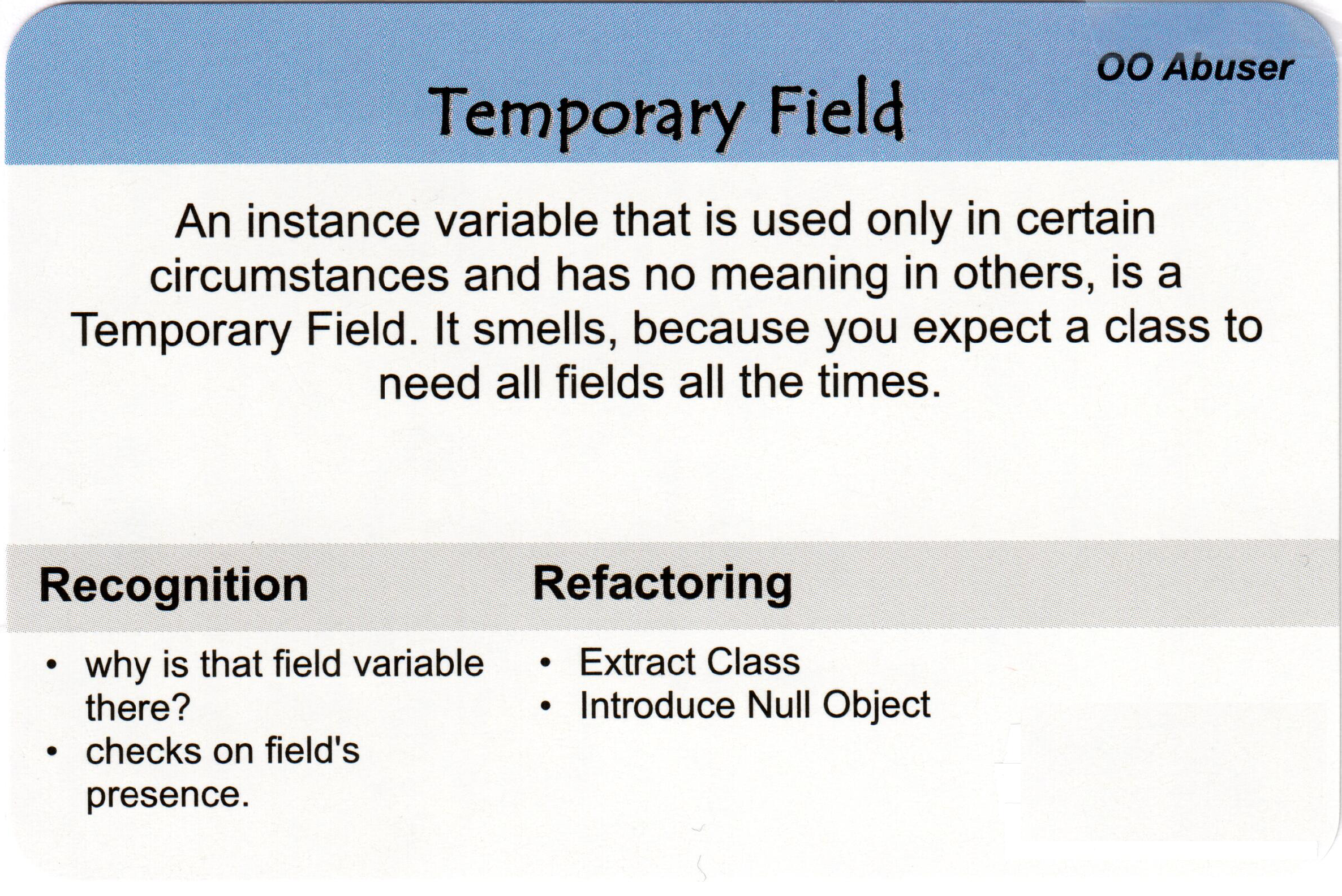
A “Temporary Field” is a code smell that occurs when a class has fields that are only used during a specific method invocation. These fields are not part of the class’s state and are used to store intermediate values or results during the method’s execution. Temporary fields can lead to confusion, maintenance challenges, and reduced code quality in the codebase. When a class contains temporary fields, it becomes harder to understand, maintain, and extend the system.
The term “Temporary Field” highlights the fact that the fields are temporary in nature and are only used during a specific method invocation. These fields do not represent the class’s state and are not part of its core functionality.
Temporary Fields can lead to several issues:
Confusion: When a class contains temporary fields, it can be confusing to understand the purpose and usage of these fields. Developers may struggle to differentiate between temporary and permanent fields, leading to misunderstandings and errors.
Maintenance Challenges: Temporary fields can make the code harder to maintain and evolve. Changes in the method’s logic may require modifications to the temporary fields, increasing the risk of introducing bugs and inconsistencies.
Reduced Readability: Classes with temporary fields can be harder to read and understand. The presence of additional fields that are not part of the class’s state can clutter the code and distract developers from the core functionality.
Solution#
Extract Method: Identify the method that uses the temporary fields and extract it into a separate class. This will help in encapsulating the temporary fields within the method’s scope and reducing their visibility to other parts of the class (see also Functions are Friends).
Introduce Null Object: If the temporary fields are used to handle null or default cases, consider introducing a null object to represent the absence of a value. This will help in simplifying the code and providing a consistent behavior for missing or default cases.