Lazy Class#
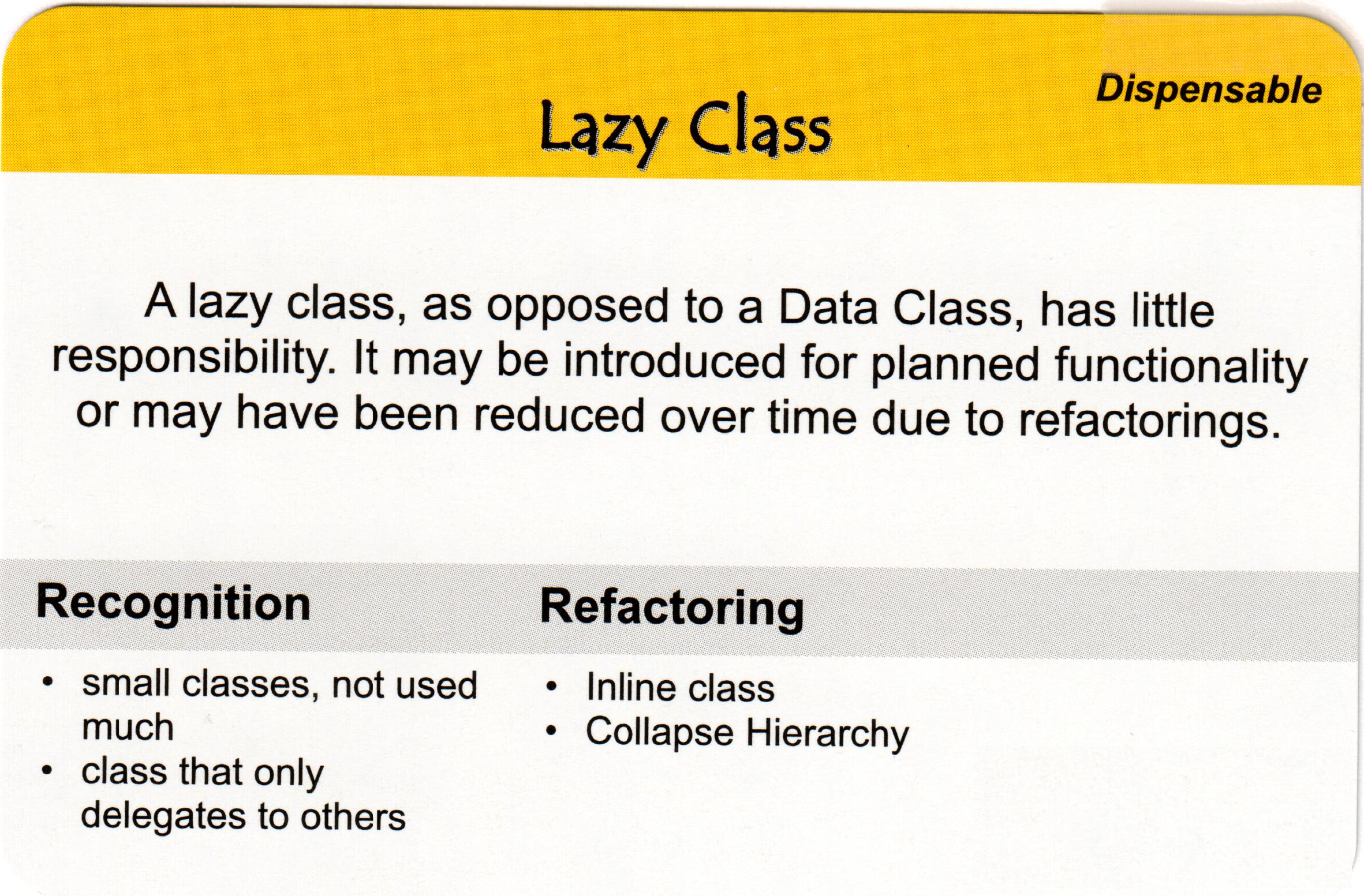
A “Lazy Class” is a code smell that occurs when a class is not doing enough to justify its existence. This smell indicates that the class is underutilized or unnecessary, and its responsibilities could be better handled by other classes or functions. A lazy class can add unnecessary complexity to the codebase and make it harder to understand, maintain, and evolve.
The term “Lazy Class” highlights the fact that the class is not pulling its weight in the system. In a well-designed system, each class should have a clear and focused purpose, encapsulating a specific set of responsibilities. When a class is not actively contributing to the system’s functionality, it can be a sign of poor design or unnecessary abstraction.
Lazy classes can lead to several problems:
Reduced Readability: When a class is not actively contributing to the system, it can add unnecessary complexity and clutter to the codebase. This can make it harder for developers to understand the system’s structure and behavior.
Maintenance Challenges: Lazy classes can make the code harder to maintain and evolve. Developers may need to spend extra time understanding the purpose and functionality of the class, even though it is not actively used.
Increased Complexity: Unnecessary classes can add complexity to the system, making it harder to reason about and extend. This can lead to a more convoluted and error-prone codebase.
Solution#
Inline Class: If the class is not actively contributing to the system and its responsibilities can be handled by other classes or functions, consider inlining its functionality. This will reduce the complexity and clutter in the codebase.
Collapse Hierarchy: If the class is part of an inheritance hierarchy but does not add value beyond its superclass, consider collapsing the hierarchy and simplifying the class structure.