Switch Statement#
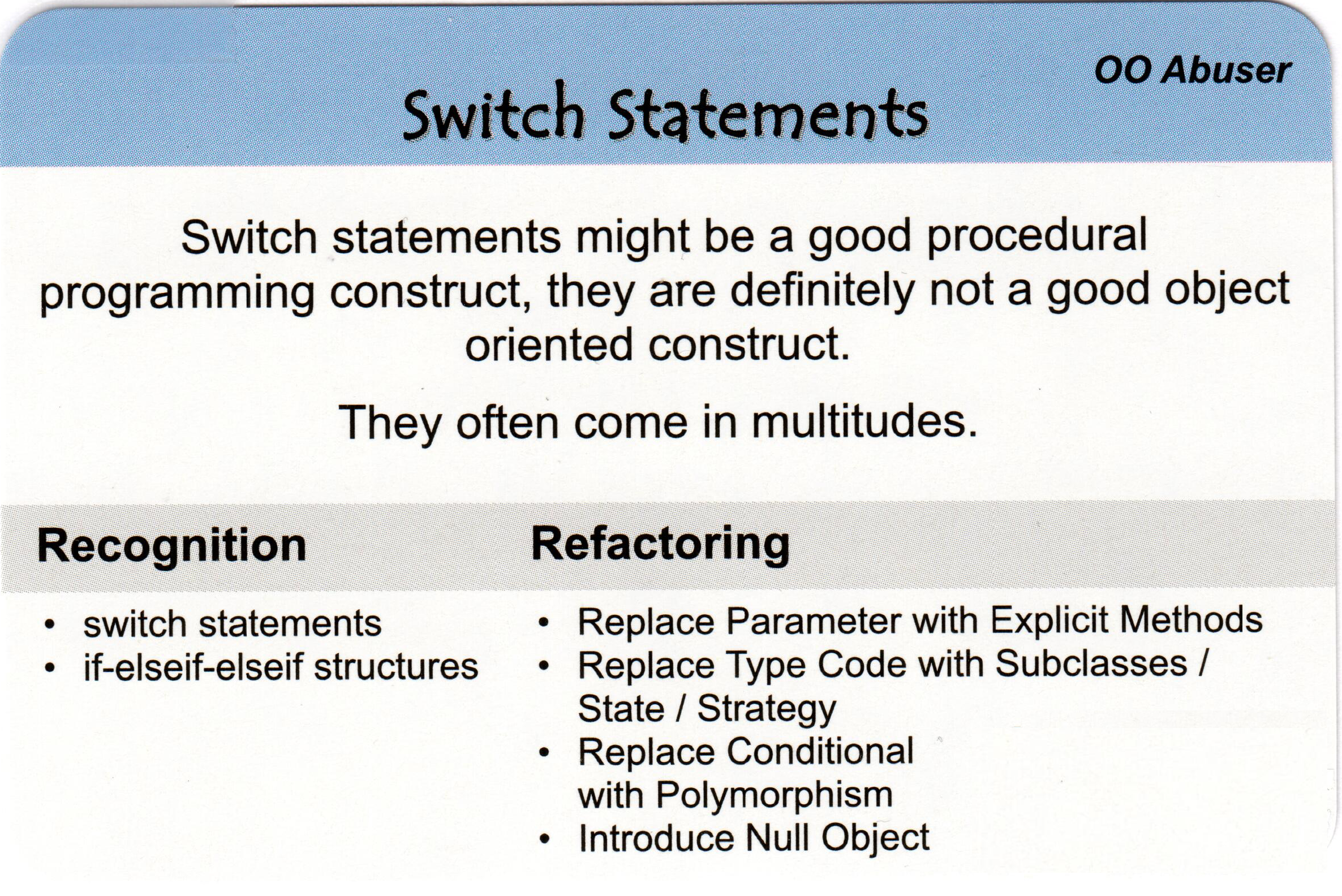
The “Switch Statement” code smell occurs when a switch or case statement is used to select behavior based on the type or state of an object. This smell can lead to several issues, including poor maintainability, reduced flexibility, and increased complexity. Switch statements violate the Open–Closed principle, which states that classes should be open for extension but closed for modification. When new types or states are added, the switch statement must be updated, leading to code duplication and potential errors.
The term “Switch Statement” highlights the use of a switch or case statement to select behavior based on the type or state of an object. This can lead to a monolithic block of code that is hard to understand, maintain, and extend. The same goes for long if-else chains/structures, which can be considered a variation of the switch statement smell.
Solution#
Replace Conditional with Polymorphism: Identify the switch statement and replace it with polymorphic behavior. Create subclasses or apply the Strategy pattern for each type or use the State pattern and delegate the behavior to them. This will help in adhering to the Open–Closed principle and make the code more flexible and maintainable.
Introduce Null Object: If the switch statement handles null or default cases, consider introducing a null object to represent the absence of a value. This will help in simplifying the code and providing a consistent behavior for missing or default cases.
Replace parameter with explicit method: If the switch statement is based on a parameter, consider replacing the parameter with a method call on the object itself. This will help in encapsulating the behavior within the object and reducing the need for external switches.