Duplicate Code#
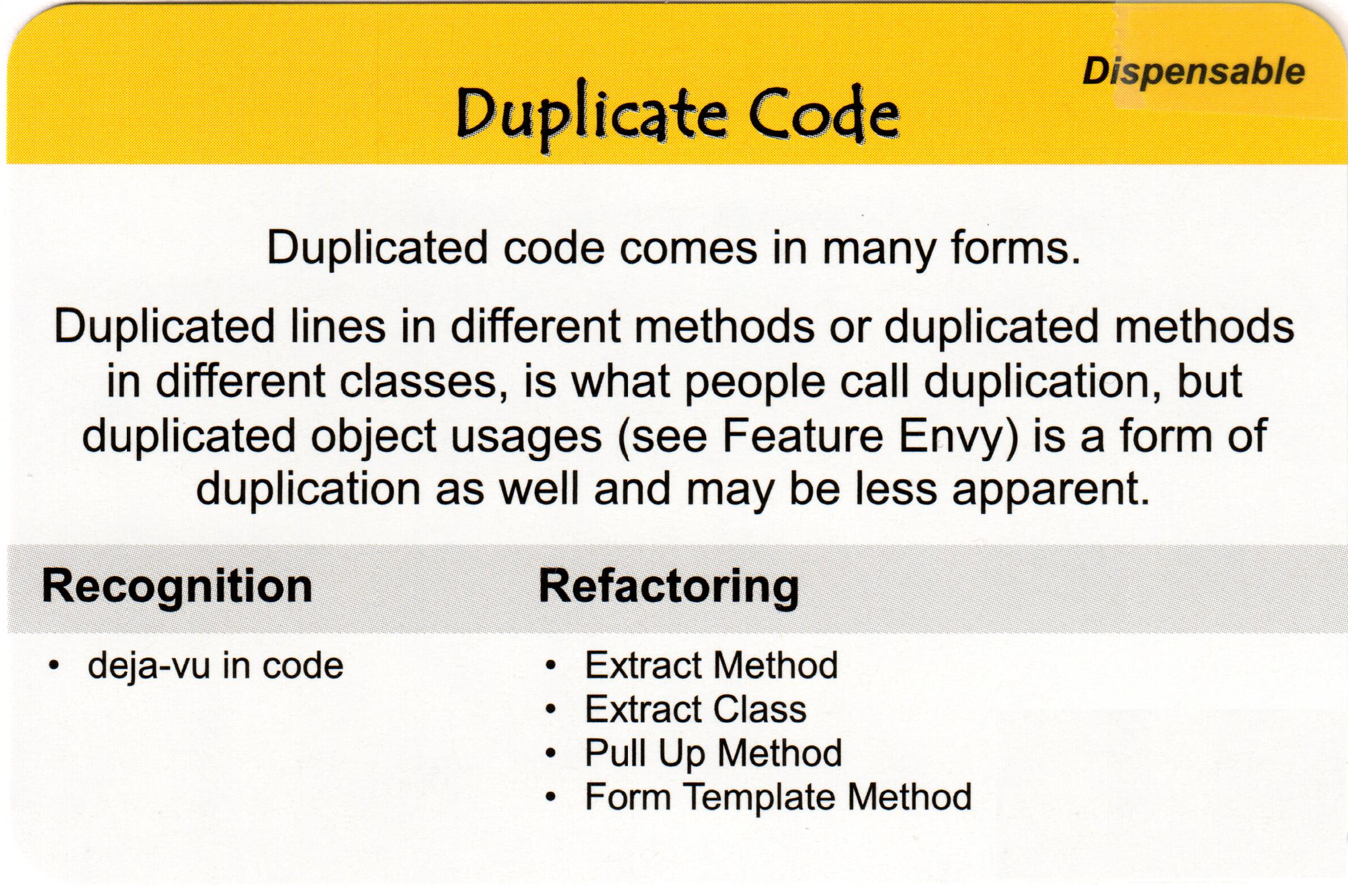
Duplicate code is a code smell that occurs when the same or similar code fragments appear in multiple places within the codebase. This redundancy can lead to several problems, including maintenance challenges, code duplication, and inconsistencies. Duplicate code can make the codebase harder to understand, maintain, and extend, as changes need to be applied in multiple places, increasing the risk of errors and inconsistencies.
The presence of duplicate code can indicate several underlying issues:
Maintenance Challenges: When the same logic or functionality is repeated in multiple places, making changes or fixing bugs becomes more complex and error-prone. Developers need to ensure that all instances of the duplicated code are updated consistently, which can be challenging and time-consuming.
Reduced Readability: Duplicate code can make the codebase harder to read and understand. When the same logic is repeated in multiple places, it can be difficult to follow the flow of the code and understand its behavior.
Increased Complexity: Duplicate code adds unnecessary complexity to the codebase. When the same logic is implemented in multiple places, it can be harder to maintain, extend, and refactor the code, leading to a more convoluted and error-prone system.
Solution#
Extract Method: Identify the duplicated code fragments and extract them into a separate method or function. This will reduce redundancy and make the code easier to maintain and evolve (see also Functions are Friends)
Extract Class: If the duplicated code involves multiple methods or fields, consider extracting a new class to encapsulate the common behavior. This will help in organizing related functionality and reducing duplication.
Template Method: If the duplicated code involves similar sequences of steps with variations, consider using the Template Method pattern to define a common structure with customizable steps.
Strategy Pattern: If the duplicated code involves different algorithms or behaviors, consider using the Strategy pattern to encapsulate the variations and make the code more flexible and maintainable.
Pull Up Method: If the duplicated code exists in multiple subclasses, consider moving the common behavior to a superclass using the Pull Up Method refactoring. This will help in reducing duplication and improving code reuse.