Data Class#
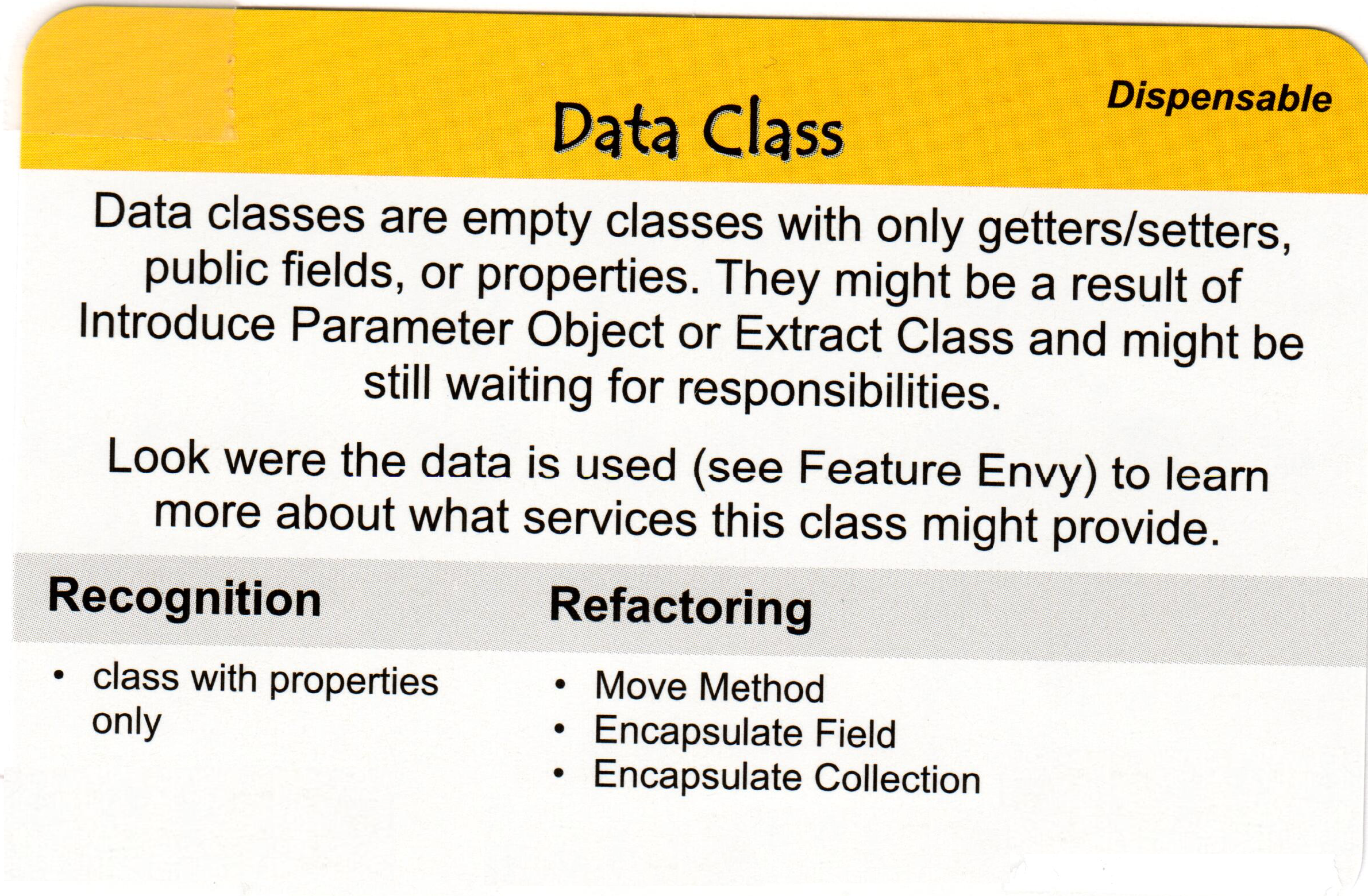
A “Data Class” is a code smell that occurs when a class contains only data fields (instance variables) without any behavior (methods). These classes are often used to store data and provide access to it, but they lack any meaningful functionality or behavior. Data classes can lead to poor encapsulation, low cohesion, and high coupling in the codebase. See also General Responsibility Assignment Software Patterns (GRASP) and Anemic Domain model.
The term “Data Class” is derived from the fact that these classes primarily serve as data containers, holding information that is passed around in the system. While data classes are a common pattern in many applications, having too many of them can indicate a design issue where responsibilities are not properly distributed among classes. Closely related to Feature envy.
Data classes can lead to several problems:
Low Cohesion: Data classes often exhibit low cohesion, as they do not encapsulate related behavior or functionality. This can lead to scattered code and a lack of clear responsibilities.
High Coupling: Data classes are often used by other classes to access or modify data, leading to tight coupling between different parts of the system. Changes in the data class can have a cascading effect on other classes.
Reduced Encapsulation: Data classes expose their internal details (data fields) to other classes, violating the principle of encapsulation. This can lead to dependencies on specific implementations and reduce the flexibility of the system.
Maintenance Difficulty: Data classes are often modified by multiple classes, making it harder to predict the impact of changes. This can result in unintended side effects and increase the risk of errors.
Limited Reusability: Data classes do not provide reusable behavior or functionality, limiting their usefulness in the system. This can lead to duplicated code and reduced maintainability.
Solution#
Encapsulate Fields: Instead of directly accessing the data fields of a data class, encapsulate them with getter and setter methods. This will help in controlling access to the data and enforcing validation or business rules.
Move Method: If behavior is needed in a data class, consider moving it to a more appropriate class that has the necessary context or responsibility.
Encapsulate Collection: If a data class contains a collection (e.g., a list or map), encapsulate the collection with methods that provide higher-level operations. This will help in managing the collection and enforcing constraints or invariants.