Train Wrecks#
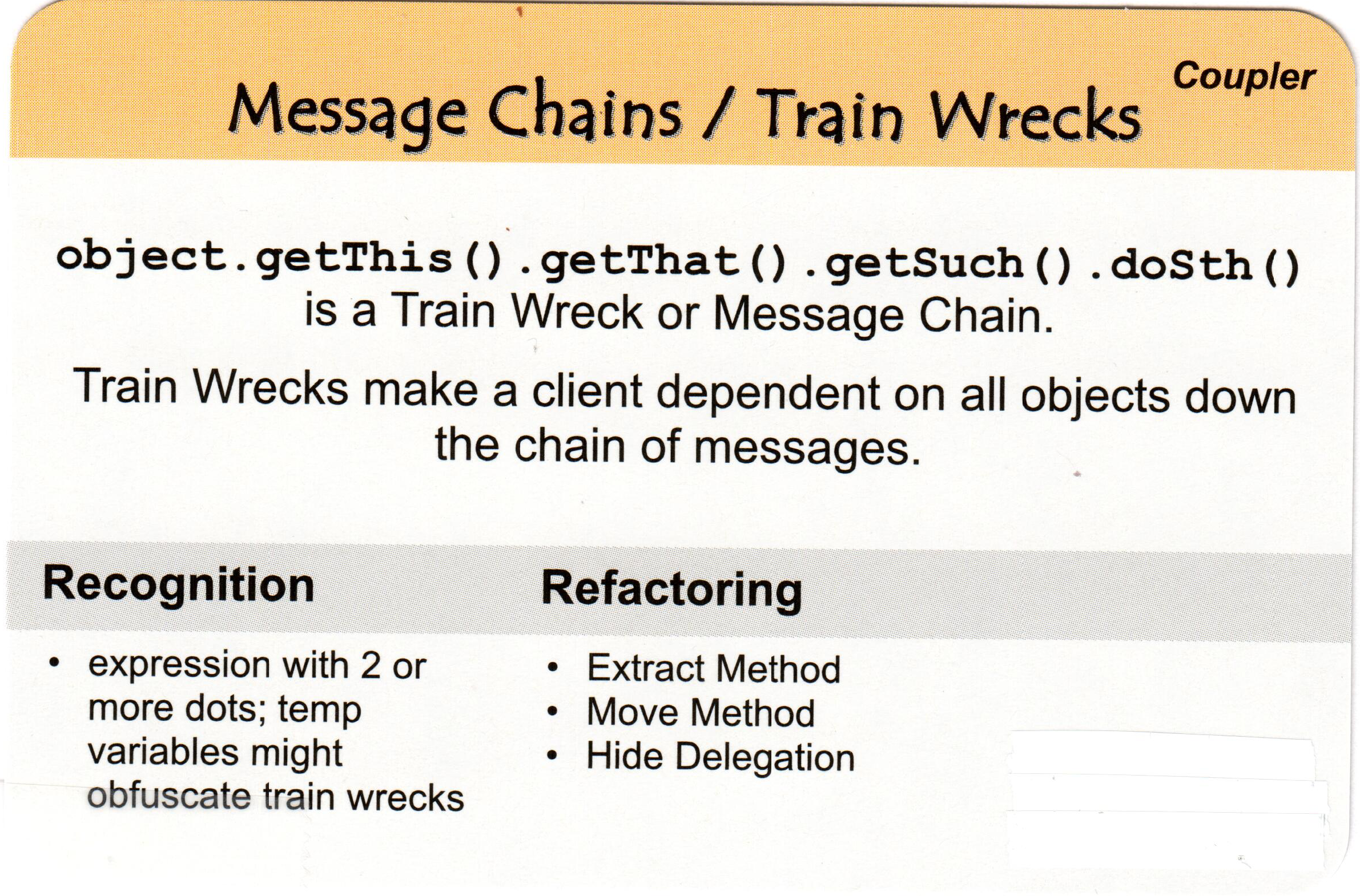
Train Wrecks is a code smell that occurs when a series of method calls or property accesses are chained together, creating a long sequence of calls that can be hard to read and maintain. This smell is also known as Message Chains, as it involves passing messages between objects in a long chain of calls.
The term “Train Wrecks” is derived from the analogy of a train wreck, where multiple train cars are linked together and derail in a catastrophic manner. In software development, this smell arises when a single object retrieves another object, which in turn retrieves another object, and so on, creating a long chain of dependencies.
Train Wrecks can lead to several problems:
Reduced Readability: Long chains of method calls can be hard to read and understand, especially when they involve multiple objects and intermediate steps. This can make the code harder to maintain and debug.
High Coupling: Train Wrecks create tight coupling between the objects involved in the chain. Changes to one object can have a cascading effect on other objects in the chain, leading to a fragile and tightly coupled design.
Low Encapsulation: Long chains of method calls can expose the internal structure of objects, violating the principle of encapsulation. This can make the code harder to maintain and evolve over time.
Maintenance Difficulty: When objects are tightly coupled through long chains of method calls, making changes to one object can require modifications to multiple objects in the chain. This can increase the risk of errors and make the code harder to maintain.
- Debugging Challenges: When an error occurs in a long chain of method calls, it can be challenging to trace the source
of the problem and identify the root cause. This can lead to longer debugging cycles and increased frustration for developers.
Solution#
Extract Method (see also Functions are Friends).
Move Method
Hide Delegation. If a method is accessing another object through a long chain of calls, consider introducing an intermediary object that acts as a delegate. This delegate can encapsulate the interactions between the objects and provide a cleaner interface.